Introduction
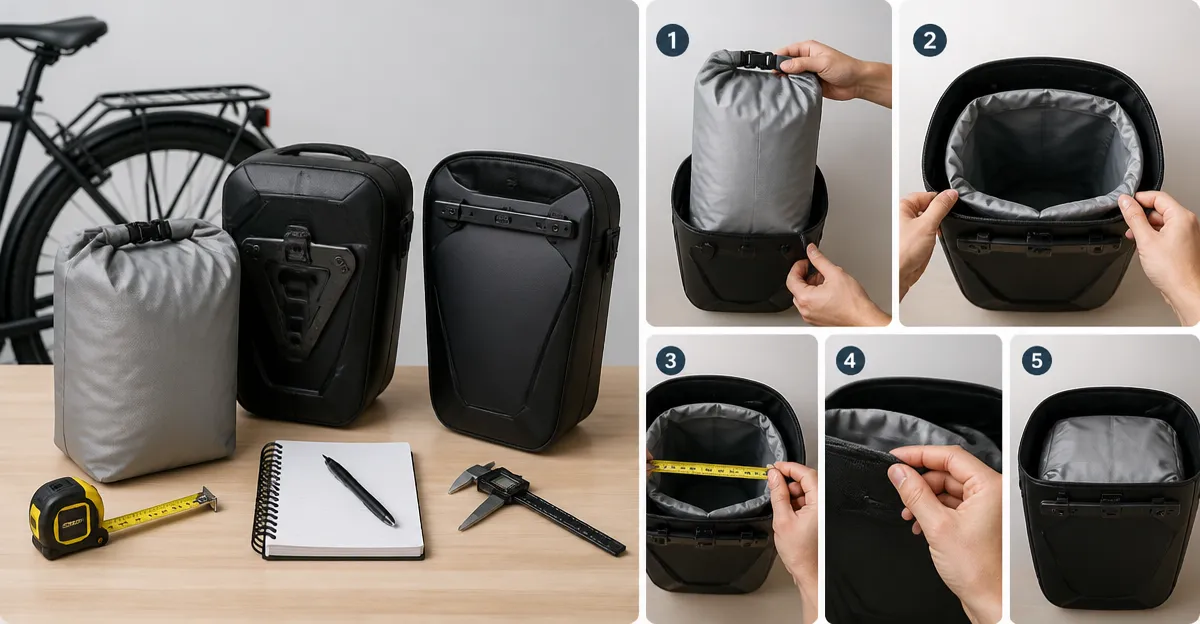
Choosing the right liner for a pannier system can prevent water damage, reduce wear, and improve overall ride comfort. This guide explains how to determine whether an Ortlieb liner will fit Topeak or Thule panniers, using a systematic approach that leverages proven Ortlieb products as measurement tools. Readers will gain confidence in assessing compatibility, avoid costly mismatches, and learn best‑practice installation techniques. The information is valuable for cyclists who demand reliability and for anyone planning a long‑distance touring adventure.
What You'll Need
- Measuring tape or ruler (minimum 150 mm)
- Flat surface for laying out panniers
- Secure mounting rack compatible with your bike
- Ortlieb Back‑Roller Plus – serves as a reference pannier for dimension checks (price $195.00, rating 4.8/5)
- Ortlieb Back‑Roller Classic – offers a classic roll‑top closure for testing strap attachment (price $199.00, rating 4.7/5)
- Ortlieb Back‑Roller City – includes inserts for rack diameter verification (price $170.00, rating 4.6/5)
- Ortlieb Front‑Roller City – useful for front‑mount compatibility checks (price $145.00, rating 4.6/5)
- Pen and notebook for recording measurements
Step 1: Identify the Liner Dimensions
The first task is to obtain the exact internal dimensions of the Ortlein liner you intend to use. Ortlieb liners typically follow the dimensions of their corresponding pannier models. For example, the Back‑Roller Plus provides a spacious interior of approximately 25 L, with a width of 300 mm, height of 280 mm, and depth of 200 mm. Record these figures precisely, as they will be compared against the interior volume of the Topeak or Thule pannier.
Step 2: Measure the Pannier Mount Points
Next, examine the mounting points on the Topeak or Thule pannier. Measure the distance between the Quick‑Lock hooks or the traditional strap loops. Many Topeak models use a 2.1 mm QL system, which aligns directly with Ortlieb's QL2.1 mechanism. If the distance matches the 2.1 mm standard, the liner will attach without modification. Use the Back‑Roller Classic as a physical comparator; its built‑in QL2.1 hooks provide a reliable reference.
Step 3: Verify Rack Compatibility
Ortlieb panniers are engineered for rack diameters up to 16 mm. The Back‑Roller City includes 8 mm and 11 mm inserts that demonstrate how the bag adapts to different rack sizes. Place the inserts into the Topeak or Thule rack and ensure a snug fit without wobble. If the rack exceeds 16 mm, the liner may not seal properly, and additional adapters may be required.
Step 4: Test the Roll‑Top Closure Alignment
The roll‑top closure is a defining feature of Ortlieb panniers. Align the liner's roll‑top seam with the pannier's top edge. The Back‑Roller Plus showcases a sleek roll‑top that locks securely when the strap is pulled tight. Close the liner inside the pannier and simulate a full load. Observe whether the seam remains flat and waterproof; any gaps indicate incompatibility.
Step 5: Assess Reflector and Visibility Integration
Both Topeak and Thule prioritize safety through high‑visibility reflectors. Ortlieb bags incorporate 3M Scotchlite reflectors on the sides and shoulder straps. The Back‑Roller Classic features large reflectors that can be compared directly to those on the target pannier. Ensure the liner does not obscure these reflectors, as doing so would diminish night‑time visibility.
Step 6: Confirm Water‑Proof Sealing
Water resistance is critical for long rides. Ortlieb's Cordura fabric, used in the Back‑Roller Plus, is both waterproof and abrasion‑resistant. Perform a simple water test by filling the liner with a small amount of water, sealing it, and placing it inside the pannier. After 15 minutes, check for any moisture on the exterior. If the pannier remains dry, the liner is compatible.
Step 7: Evaluate Carrying Comfort
When the pannier is detached, many cyclists use the shoulder strap for carrying. The Front‑Roller City includes a detachable shoulder strap that can be tested for ergonomic fit. Attach the liner, lift the assembled bag, and assess the strap's length and padding. A comfortable strap reduces strain during multi‑stop trips.
Tips & Pro Tips
- Always double‑check the QL system version; Ortlieb uses QL2.1, while some older Topeak models may use a 2.0 system.
- When measuring, record dimensions to the nearest millimeter to avoid cumulative errors.
- Consider using a silicone‑based sealant on the roll‑top seam if you anticipate extreme weather conditions.
- Store the liner in a dry environment when not in use to preserve the Cordura coating.
Troubleshooting
| Problem | Possible Cause | Solution |
|---|---|---|
| Liner does not lock onto QL hooks | Incompatible QL version | Verify that the pannier uses QL2.1; purchase an adaptor or switch to a compatible Ortlieb model. |
| Water leaks around roll‑top | Improper tension on the roll strap | Re‑tighten the strap until the seam is flush; test again with the water test. |
| Reflectors are obscured | Liner is too thick | Choose a slimmer liner model such as the Back‑Roller Classic. |
Conclusion
By following the seven steps outlined above, one can confidently determine whether an Ortlieb liner will fit a Topeak or Thule pannier. The process emphasizes precise measurement, compatibility of the QL system, roll‑top alignment, and waterproof performance. Utilizing the recommended Ortlieb products as reference tools ensures accuracy and saves time. Armed with this knowledge, cyclists can embark on their journeys with the assurance that their gear will remain protected and accessible.
Frequently Asked Questions
How can I tell if an Ortlieb liner will fit my Topeak or Thule pannier?
Measure the interior width, height, and strap attachment points of the Topeak/Thule pannier and compare them to the dimensions of an Ortlieb reference model such as the Back‑Roller Plus.
What dimensions should I check when comparing liners to panniers?
Check the internal length, width, and depth (minimum 150 mm width) as well as the distance between mounting hooks or strap loops.
Do Ortlieb Back‑Roller Plus and Classic liners work as universal fit guides?
Yes, they provide standard Ortlieb dimensions and strap locations that can be used to verify compatibility with most Topeak and Thule bags.
Is any special installation technique required for an Ortlieb liner in a non‑Ortlieb pannier?
Place the liner flat, align the strap holes with the pannier’s hooks, and secure with the original Ortlieb straps or compatible buckles for a snug fit.
Where can I purchase an Ortlieb liner for testing compatibility?
Ortlieb liners are available on Amazon (e.g., Back‑Roller Plus at $195, Back‑Roller Classic at $199) and through authorized bike‑accessory retailers.